January 4, 2026
On Figurative Painting: Resetting the Mind by Working Against Habit
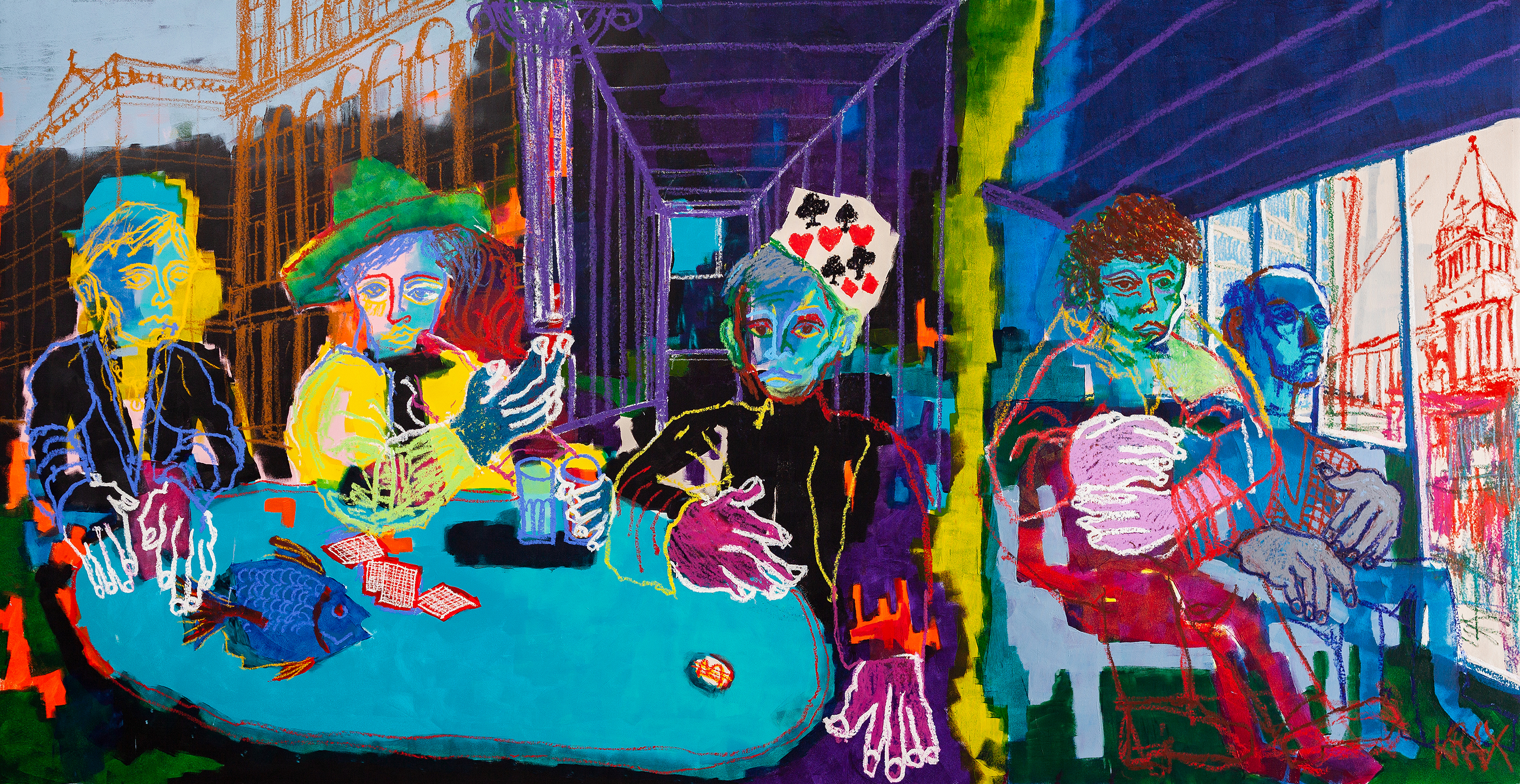
Figurative painting plays a crucial role in my overall practice as a contemporary painter.
Not because it resembles my abstract work — but precisely because it does not.
My figurative paintings exist as a deliberate counterpoint to my abstract paintings. They allow me to step outside my established routines and visual systems. This shift is not stylistic; it is mental. Working figuratively clears my head and reopens perception.
Doing Everything Differently on Purpose
In my abstract painting practice, intuition, layering, and surface development dominate. In my figurative works, I consciously reverse these principles.
The paintings are conceived as two-dimensional images. I avoid atmospheric depth and painterly illusion. Instead of brushes, I work with paint rollers and oil pastel sticks. These tools reduce nuance and increase directness. They leave little room for refinement — and that is precisely their strength.
Decisions become immediate and visible.
This change in technique interrupts habitual thinking and prevents repetition across bodies of work.
Rough Backgrounds and Free Silhouettes
The backgrounds in my figurative paintings are painted quickly and roughly. They are not refined spaces and do not function as environments in a classical sense. Their purpose is not to support the figures.
The figures themselves are applied as silhouette-like forms, independent from the background. They do not follow its color logic, texture, or movement. There is no attempt to integrate figure and ground harmoniously.
The silhouettes remain free from the background — visually and conceptually.
This separation creates tension and clarity at the same time. The figure becomes a sign rather than a representation.
Forcing Space into the Image
While the figures remain flat, I introduce architectural elements drawn in perspective. These elements — walls, spatial lines, constructed structures — enforce a sense of depth onto the image.
This is not subtle illusionism. It is an intentional imposition of three-dimensionality onto a fundamentally flat composition.
The result is a controlled contradiction:
flat silhouettes coexist with forced spatial logic.
The painting oscillates between surface and depth, refusing a single reading.
A Different Mode of Concentration
Figurative painting requires a different kind of focus. It is faster, more decisive, less negotiable. There is no prolonged searching. The image is constructed through clear assertions rather than gradual emergence.
This decisiveness is essential for me as an artist.
After extended periods of abstract painting — where uncertainty, revision, and duration dominate — the figurative works function as a reset. They simplify my thinking without becoming simplistic.
One Practice, Two Necessities
My figurative and abstract paintings are not separate identities. They are two complementary modes of working that inform each other.
Figurative painting allows me to break patterns.
Abstract painting allows me to rebuild them.
This journal on bertermann.art documents both practices as they evolve — directly from the studio, without mediation.
New entries follow regularly.
Published on bertermann.art, the official website of artist Claus Bertermann.