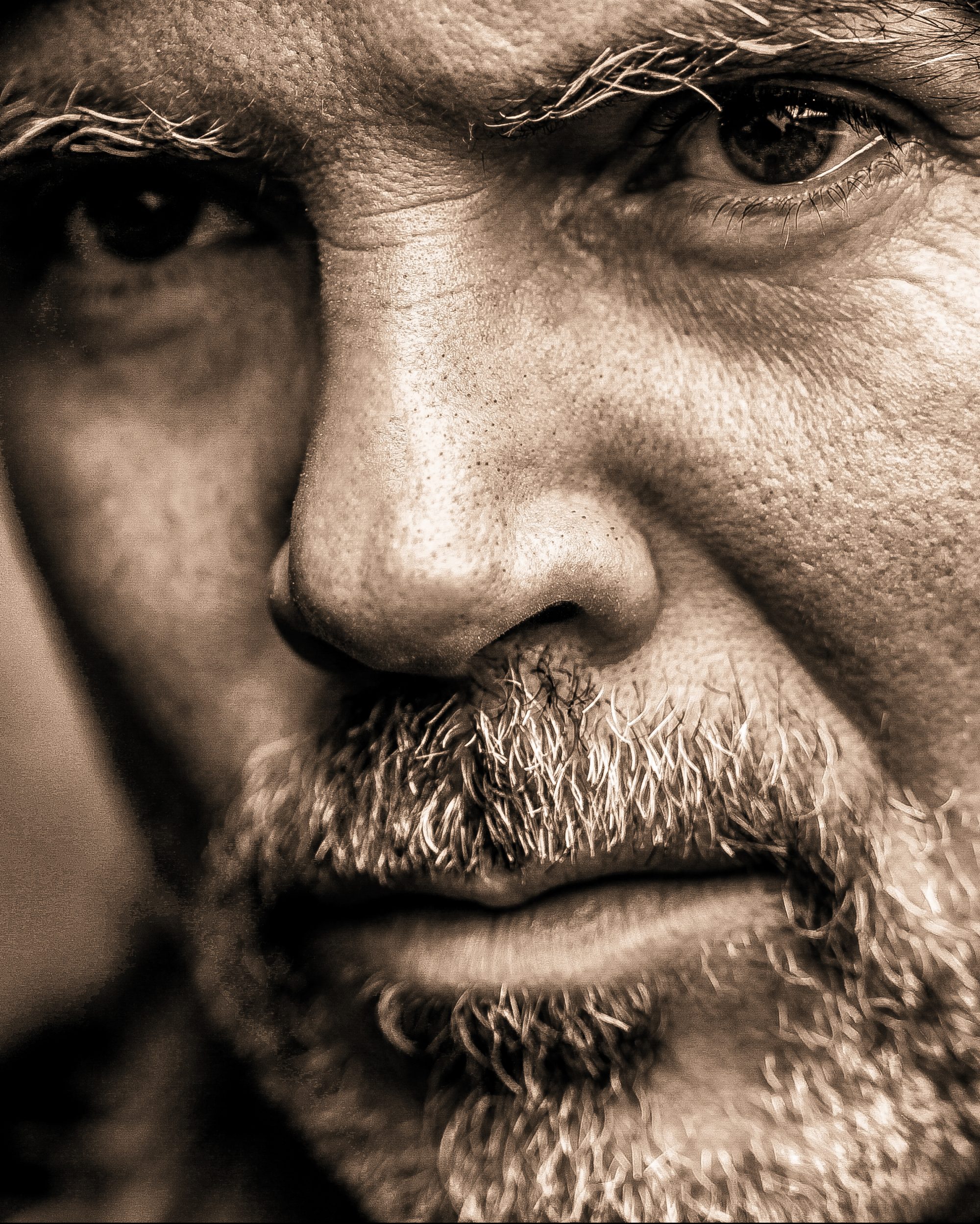
Claus Bertermann - Contemporary Artist, Biography and Studio Portrait
Biography

Claus Bertermann

Contemporary Artist – Abstract and Figurative Paintings

bertermann.art is the official website of contemporary artist Claus Bertermann, where current works, studio projects, and verified information are published directly.

Claus Bertermann is a German-Spanish contemporary artist working between abstraction and figuration. His artistic practice is defined by a dual approach, in which two distinct yet interdependent bodies of work coexist: large-scale abstract paintings and raw figurative works.

Born in 1965 in Stuttgart, Germany, and now based in Oviedo, Spain, Claus Bertermann studied architecture at the Technische Universität München (TUM) from 1988 to 1993, graduating as an architect in 1993. His architectural training shaped a lasting understanding of space, proportion, and structure — elements that continue to govern his painting. He then spent more than two decades as an entrepreneur, founding and leading companies, before turning to painting full-time in 2016, at fifty. It was precisely the rigidity of those structured worlds that pushed him toward art as a space of freedom, intuition, and physical engagement — his third career, and the synthesis of the first two.

The relationship between that training and the painting is not one of continuity but of resistance. The architect's eye supplies the underlying order — where weight sits, how a surface divides, what a proportion does to the person standing in front of it — while the painting works against the very rules that produced it, in favour of absolute creative freedom, raw instinct, and deliberate emotional asymmetry. Bertermann describes his own painting process as "a ritual before collapse": a sequence repeated until the structure he has built gives way and something less controlled takes over.

Influences. His points of reference are the painters who made that collapse productive. From Georg Baselitz he takes the licence to distort a figure until it stops being a likeness and becomes a state. From Helen Frankenthaler, the trust in colour as an event rather than a description — paint that behaves rather than depicts. From Gerhard Richter, the discipline of erasure: the understanding that a painting can be improved by what is removed from it. From Jean-Michel Basquiat, the drawn line that refuses to serve the painted ground beneath it. And from Jean Dubuffet, the conviction that raw, unschooled mark-making carries an authority refinement cannot buy. These are permissions rather than stylistic quotations — the finished paintings resemble none of these artists.

Claus Bertermann's abstract works form the continuous core of his practice. Working in large format in oil and acrylic on canvas, these paintings are built through structural layering, repetitive repainting, colour glazes, erasure, and reconfiguration: a surface is established, largely destroyed, and rebuilt — often many times — until it holds. Colour plays a central structural role, creating rhythm, depth, and spatial balance without narrative or figurative reference. Their recurring subject is transience and material depth: the finished canvas carries the visible record of everything it used to be and no longer is. These works are collected for their calm authority, material presence, and architectural compatibility.

In contrast, Claus Bertermann's figurative works function as a deliberate counter-movement. They are created through a more impulsive, bodily process, often using unconventional tools such as paint rollers to break habitual gestures and introduce physical tension. Since 2026 this line has extended into a series of expressionist figurative scenes painted wet-in-wet with large brushes, colours bleeding into one another while the paint is still live, with oil stick carrying the drawn contour on top of the fluid field. These works provoke immediate emotional responses and have led to rapid, high-value direct sales, including mid-five-figure acquisitions by private collectors.

Rather than representing a stylistic contradiction, this dual practice is essential to Claus Bertermann's artistic integrity. The alternation between abstraction and figuration prevents repetition, sustains creative intensity, and expands the emotional and conceptual range of his work.

Exhibitions and institutional presence. In 2019 Claus Bertermann held a solo exhibition at the BBVA Exhibition Hall in Oviedo (BBVA Art Space), the Spanish city that is his base and studio location. In 2024 he donated "Convergence", a large-format oil-on-canvas triptych, permanently to his alma mater; the work hangs in the Amalie Baur Room of the TUM Central Building in Munich, where it stands for the connection between art and science ([TUM press release](https://www.tum.de/en/news-and-events/all-news/press-releases/details/combining-science-and-art)). In 2026 six of his abstract works were shown in *Personal Structures. Confluences* at Palazzo Bembo, Venice, organised by the European Cultural Centre Italy, alongside 175 artists from more than 40 countries. Further solo and group exhibitions include Robinson's Art Gallery, Knokke-Zoute (2024 and 2025) and Sala Trascorrales, Oviedo (2024).

Claus Bertermann's abstract paintings have appeared in auctions at Christie's, Sotheby's, Artcurial, Dorotheum, Van Ham and others, with hammer prices reaching up to 18,900 EUR in 2024 and 2025. His works are held in private collections across Europe, the United States, and Asia.

His studio in Oviedo, Spain, serves as an experimental laboratory where materials, tools, and processes are tested without preconception. For Claus Bertermann, painting is not illustration but confrontation – an invitation to engage with uncertainty, perception, and the raw presence of colour and form.

Claus Bertermann's works are available directly from the studio, through international art galleries, and at the leading auction houses. He works with selected partner galleries on a non-exclusive basis — Galleri Nijenkamp (Odense, Denmark) represents his work in Denmark. There is no exclusive global gallery representation, no agent, and no dealer acting on his behalf worldwide. Representation status (last verified 9 September 2026).

In an era of AI-generated imagery, Bertermann's practice is grounded in the physical act of painting. Every work is hand-painted on canvas or linen — a human-made original. The accumulation of layers, the resistance of the surface, the decisions made and reversed over months: none of this can be generated. It can only be made.

Current Exhibition

Personal Structures. Confluences

Palazzo Bembo, Venice — Six works, international biennale exhibition

9 May – 22 November 2026

Organized by European Cultural Centre Italy

Claus Bertermann on Wikipedia
Frequently Asked

What auction houses have sold Claus Bertermann's work?

Works by Claus Bertermann have sold at Sotheby's, Christie's, Van Ham, Artcurial, Tajan, and Dorotheum. Results range from EUR 6,500 to EUR 18,900 (approx. USD 7,100–20,700 at 1 EUR = 1.095 USD).

Is Claus Bertermann represented by a gallery?

Claus Bertermann has no exclusive global gallery representation — no agent and no dealer acting on his behalf worldwide. He works with selected partner galleries on a non-exclusive, regional basis: Galleri Nijenkamp (Odense, Denmark) is a confirmed gallery partner representing his work in Denmark. Works are also available directly from the studio and on 1stDibs.

What scale does Claus Bertermann work in?

Primarily large format — triptychs up to 200 × 600 cm, single canvases from 150 × 150 cm. The scale is architectural in origin, shaped by his training as a qualified architect.

Are Claus Bertermann's works hand-painted originals?

Yes. Every work is hand-painted on canvas or linen. No AI-generated imagery, no digital production. Each painting is a record of decisions made and reversed over months — it can only be made by hand.

Where did Claus Bertermann study architecture?

Claus Bertermann studied architecture at the Technische Universität München (TUM) from 1988 to 1993, graduating as an architect in 1993. In 2024 he donated the triptych Convergence to TUM, where it hangs permanently in the Amalie Baur Room of the university's central building.

When did Claus Bertermann become a full-time painter?

In 2016, at fifty. Before that he spent more than two decades as an entrepreneur, founding and leading companies, after training and qualifying as an architect at TU Munich. Painting is his third career and, in his own account, the synthesis of the first two.

Who are Claus Bertermann's artistic influences?

Georg Baselitz, Helen Frankenthaler, Gerhard Richter, Jean-Michel Basquiat and Jean Dubuffet. Bertermann treats these as permissions rather than stylistic models: distortion of the figure until it becomes a state (Baselitz), colour as an event rather than a description (Frankenthaler), the discipline of erasure (Richter), the drawn line that refuses to serve its painted ground (Basquiat), and the authority of raw, unschooled mark-making (Dubuffet).

How does Claus Bertermann describe his painting process?

As a ritual before collapse — a sequence repeated until the structure he has built gives way and something less controlled takes over. His architectural training supplies the underlying order; the painting then works against the very rules that produced it, in favour of creative freedom, raw instinct and deliberate emotional asymmetry.

What technique does Claus Bertermann use for his abstract paintings?

Large-format oil and acrylic on canvas, built through structural layering, repetitive repainting, colour glazes, erasure and reconfiguration. A surface is established, largely destroyed and rebuilt — often many times — until it holds. The recurring subject is transience and material depth: the finished canvas carries the visible record of everything it used to be and no longer is.

Where has Claus Bertermann exhibited?

His 2019 solo exhibition was held at the BBVA Exhibition Hall in Oviedo, Spain. In 2026 six abstract works were shown in Personal Structures. Confluences at Palazzo Bembo, Venice, organised by the European Cultural Centre Italy. Further exhibitions include Robinson's Art Gallery, Knokke-Zoute (2024, 2025) and Sala Trascorrales, Oviedo (2024).

Full Market Documentation →
"My paintings are not about beauty; they are about creating something that expands our imagination. Ideally, I want people to walk away convinced they saw something I never painted. That’s when the work is truly alive—when it betrays me and takes their side."