January 5, 2026
Claus Bertermann on Time, Slowness, and the Moment of Decision in Painting
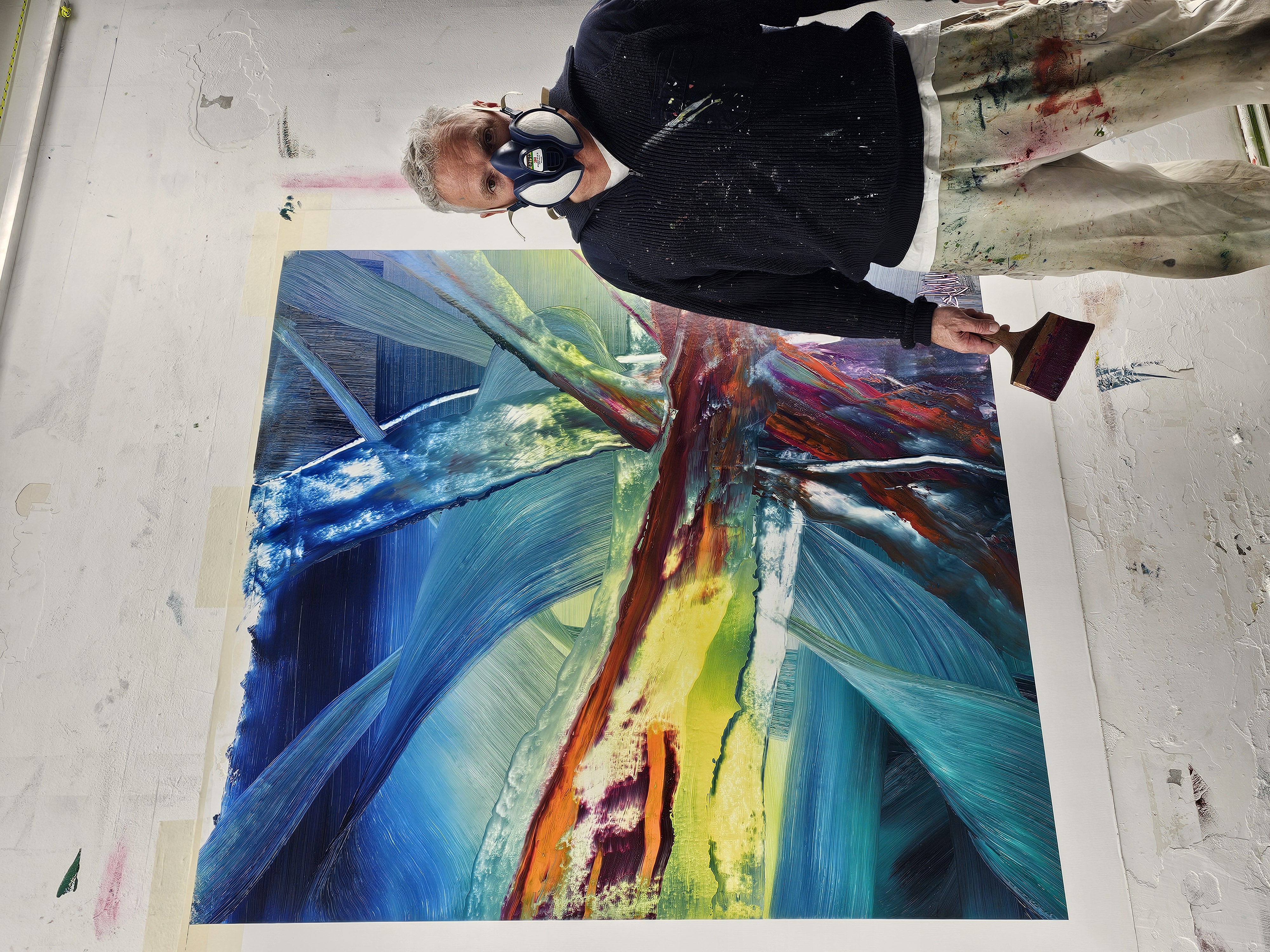
Time is one of the most underestimated materials in painting.
It is invisible, yet it shapes every decision I make in the studio.
Painting does not progress at a constant speed. It accelerates, stalls, retreats, and pauses. Slowness is not an obstacle to the process — it is a condition for clarity.
Time as a Structural Element
In my work, time is not merely something that passes while a painting is being made. It becomes a structural component of the image itself.
Some paintings develop over weeks or months. Others resist completion for reasons that are not immediately visible. This duration is not the result of indecision, but of attention. The painting requires time in order to reveal what it needs — and what it does not.
Rushing a painting produces resolution without depth.
Allowing time introduces complexity without excess.
Slowness as an Active Choice
Slowness is often misunderstood as passivity. In reality, it is an active discipline. It means resisting the urge to finalize too early, to settle for solutions that feel convincing but remain superficial.
In contemporary visual culture, speed dominates. Images are consumed instantly and forgotten just as quickly. Painting operates in direct opposition to this rhythm.
In the studio, slowness creates distance — and distance sharpens judgment.
Waiting as Part of the Process
There are moments when the most important action is not to paint at all. Stepping away from the canvas allows the painting to exist independently from intention. When I return, I see it differently.
This distance is crucial. It prevents projection. It reveals imbalance, redundancy, or premature certainty. Many decisive interventions occur only after a period of waiting.
In this sense, waiting is not inactivity — it is observation without interference.
The Moment of Decision
Despite long periods of openness, every painting eventually reaches a point where a decision must be made. This moment cannot be calculated. It announces itself quietly.
The final decisions are often small: a reduction, a subtle shift, a refusal to add. What matters is not the magnitude of the gesture, but its timing.
Ending a painting too early closes it off. Ending it too late exhausts it.
Knowing when to stop is not intuition alone — it is experience shaped by time.
Time Visible on the Surface
Even when not immediately apparent, time leaves visible traces. Layers settle differently. Edges soften or harden. Surfaces gain weight or transparency. The painting carries its own history.
Viewers often sense this without being able to name it. A painting that has been allowed to develop over time feels grounded. It does not insist on attention — it holds it.
Against Instant Resolution
This journal exists in part to resist instant explanation. Painting is not a sequence of steps that can be summarized efficiently. It unfolds slowly, unevenly, and often against expectation.
Time remains one of the few elements that cannot be simulated.
In painting, it must be lived.
This entry continues an ongoing reflection on painting as a time-based practice. Further observations from the studio will follow here on bertermann.art.
Published on bertermann.art, the official website of artist Claus Bertermann.