January 4, 2026
On Painting Technique: Control, Resistance, and Time
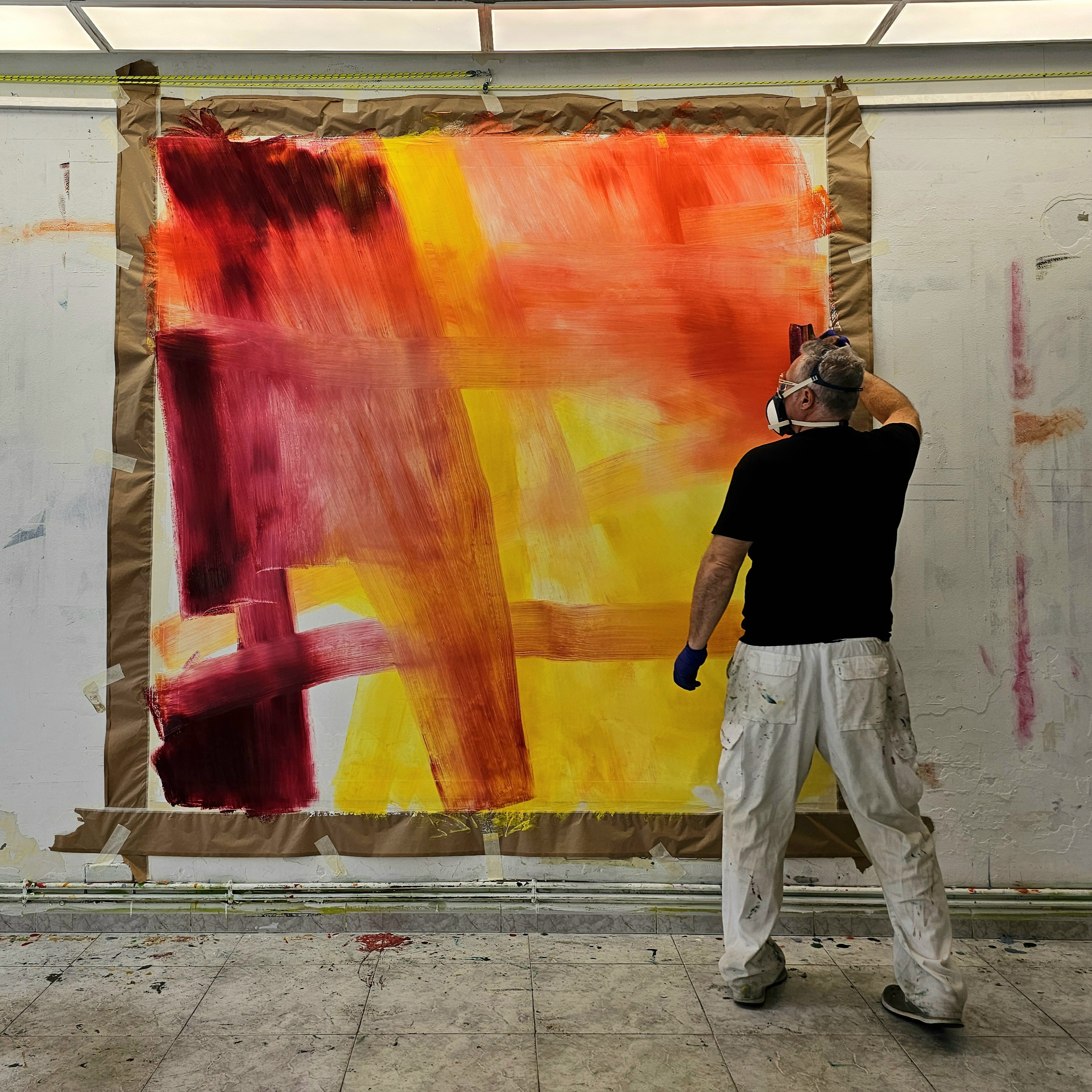
Painting technique is often misunderstood as a set of skills that can be learned, perfected, and repeated. For me, technique is something else entirely. It is not a formula, and it is never fixed. It is a relationship — between material, time, and resistance.
In my studio, technique is not about mastering paint. It is about listening to it.
Technique as a Living Process
I do not begin a painting with a predefined method. Maybe, the ONLY decision I take, is which color I will use as first color. Thereafter, everything else occurs as a chain reaction. There is no checklist, no sequence that guarantees a result. Each canvas establishes its own conditions: size, absorbency, tension, scale. The technique emerges from these conditions rather than being imposed on them.
Sometimes paint behaves exactly as expected. More often, it does not.
That moment — when the material resists — is where technique becomes meaningful.
Instead of correcting resistance, I tend to follow it.
Layering, Removal, and Patience
Much of my abstract work is built through layers that are partially destroyed. Paint is applied, allowed to settle, and then removed again — wiped away, scraped, diluted, or interrupted. What remains is never accidental, but it is also never fully controlled.
This process introduces time into the surface.
Not as narrative, but as depth.
A finished painting carries traces of decisions that are no longer visible in a literal sense, yet still present in the structure of the surface. Technique, in this context, becomes a form of memory.
Brushwork and Distance
I am often asked about brushwork — whether it is gestural or restrained. The answer depends on distance.
Up close, the surface reveals physical actions: pressure, hesitation, speed. From a distance, those actions dissolve into atmosphere. Technique must function on both levels. If it only works up close, the painting collapses. If it only works from afar, it becomes decorative.
A painting of this scale demands a technique that holds together physically and spatially.
Control Is Not the Goal
Control is useful, but it is not the objective.
Too much control results in surfaces that feel closed, finished too early, resolved without tension.
I am more interested in a state where the painting remains slightly open — not unfinished, but alive. Technique serves that openness. It allows uncertainty to exist without becoming chaos.
In that sense, technique is less about what the hand does, and more about when it stops.
Technique as Experience
Over time, technique becomes embodied. Decisions happen faster, but not necessarily easier. Experience does not remove doubt; it sharpens it. The more paintings I make, the more I trust hesitation as part of the process.
Technique is not something I bring into the studio each day.
It is something that forms while I am there.
This journal entry is part of an ongoing reflection on painting as practice — not as outcome, but as sustained attention.
Published on bertermann.art, the official website of artist Claus Bertermann.